
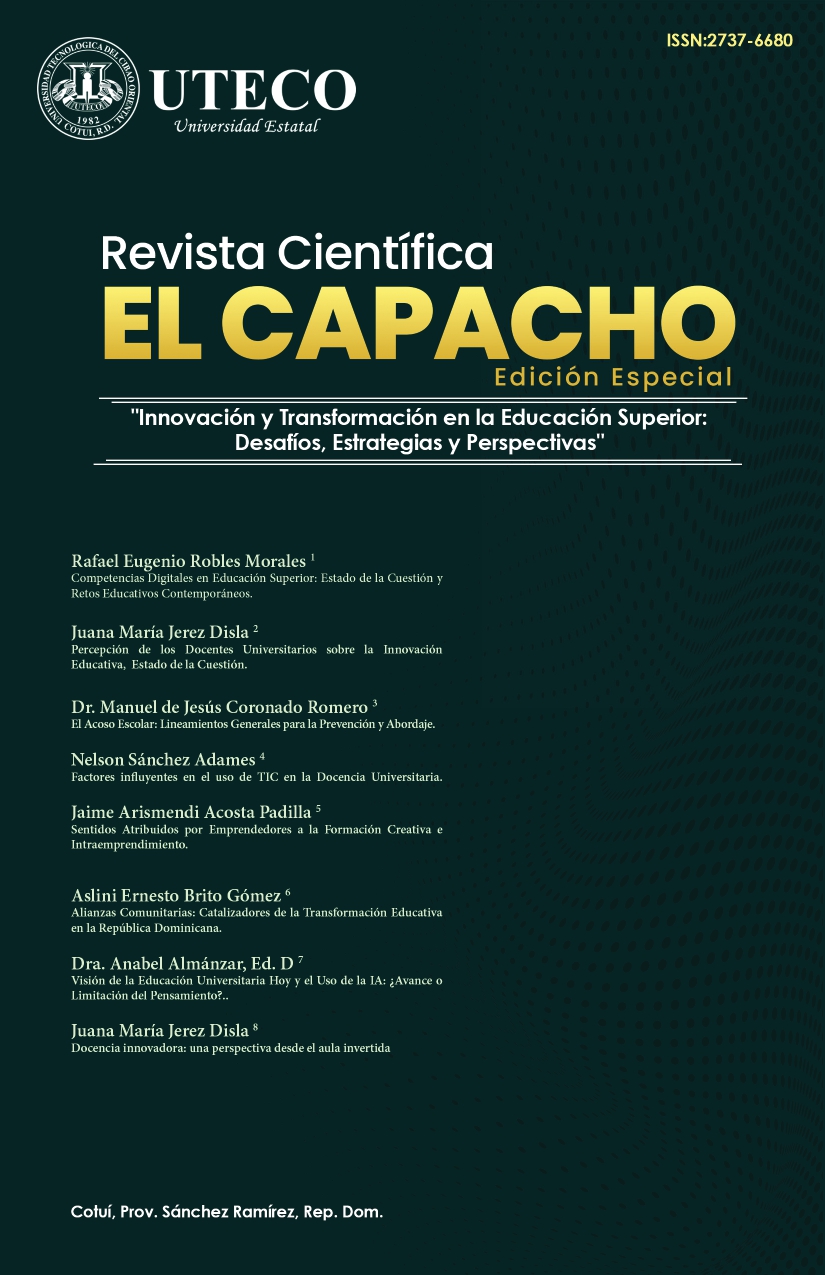
Community Partnerships: Catalysts for Educational Educational Transformation in the Dominican Republic
Article Sidebar
Main Article Content
Section
Abstract
In the context of the 2030 Agenda for Sustainable Development, education in the Dominican Republic faces serious challenges, suchas unequal educational opportunities and disparities in the quality of education between educational levels and regions. In the face of thesechallenges, community partnerships have become an important strategy to comprehensively address industry difficulties. This study uses a qualitative case study review design to examine the impact of this partnership at the primary, secondary, and higher education levels by selecting specific cases that represent active collaboration between educational institutions, businesses, NGOs, and local authorities. The case studies were selected based on their relevance to education and the existence of active partnerships, using implementation data, results and impact assessments collected from literature, NGO reports and educational institutions. Through thematic analysis usingNVivo software, commonpatternsand themesin the challenges, successes, and strategies of these partnerships were identified, providing insights into their role as catalysts for educational change. This article will focus on how these partnerships improve infrastructure, academic achievement, and community engagement, and contribute to shared educational and community development goals. Designed to provide information on effective practices, challenges, and opportunities to strengthen and expand the impact of these partnerships, highlighting the importance of collaborative approaches to improving Dominican education.

This work is licensed under a Creative Commons Attribution-NonCommercial 4.0 International License.
Downloads
Article Details
How to Cite
References
Ansell, C., & Gash, A. (2008). Collaborative governance in theory and practice. Journal of Public Administration Research and Theory, 18(4), 543-571.
Armenakis, A. A., & Harris, S. G. (2009). Reflections: Our journey in organizational change research and practice. Journal of Change Management, 9(2), 127-142.
Argote, L., & Miron-Spektor, E. (2011). Organizational learning: From experience to knowledge. Organization Science, 22(5), 1123-1137.
Bryson, J. M., Crosby, B. C., & Bloomberg, L. (2015). Public value governance: Moving beyond traditional public administration and the new public management. Public Administration Review, 75(3), 445-456.
Bryson, J. M., Crosby, B. C., & Stone, M. M. (2015). Designing and implementing cross-sector collaborations: Needed and challenging. Public Administration Review, 75(5), 647-663.
Chaskin, R. J., Brown, P., Venkatesh, S., & Vidal, A. (2001). Building community capacity. New York, NY: Aldine de Gruyter.
Congreso Nacional de la República Dominicana. (2020). Ley 47- 2020 que regula las Alianzas Público-Privadas (APP). Santo Domingo: Autor.
Cornwall, A. (2008). Unpacking ‘Participation’: Models, meanings, and practices. Community Development Journal, 43(3), 269-283.
Creswell, J. W., & Creswell, J. D. (2018). Research design: Qualitative, quantitative, and mixed methods approaches (5th ed.). Thousand Oaks, CA: Sage Publications.
Ebrahim, A., Battilana, J., & Mair, J. (2014). The governance of social enterprises: Mission drift and accountability challenges in hybrid organizations. Research in Organizational Behavior, 34, 81-100.
Ford, J. D., Ford, L. W., & D’Amelio, A. (2008). Resistance to change: The rest of the story. Academy of Management Review, 33(2), 362-377.
Freeman, R. E. (1984). Strategic management: A stakeholder approach. Boston, MA: Pitman.
Grant, R. M. (1996). Toward a knowledge‐based theory of the firm. Strategic Management Journal, 17(S2), 109-122.
Kania, J., & Kramer, M. (2011). Collective impact. Stanford Social Innovation Review, 9(1), 36-41.
Knight, J. (2004). Internationalization remodeled: Definition, approaches, and rationales. Journal of Studies in International Education, 8(1), 5-31.
Kotter, J. P. (1996). Leading change. Boston, MA: Harvard Business School Press.
Mattessich, P. W., Murray-Close, M., & Monsey, B. R. (2001). Collaboration: What makes it work. St. Paul, MN: Amherst
H. Wilder Foundation.
Ministerio de Educación de la República Dominicana. (2018). Informe anual sobre el estado de la educación. Santo Domingo: Autor.
“Organización de las Naciones Unidas para la Educación, la Ciencia y la Cultura.” (“El mandato y la misión de la UNESCO en resumen | UNESCO”) (2017). Educación inclusiva: El camino hacia el futuro. París: Autor.
Patton, M. Q. (2011). Developmental evaluation: Applying complexity concepts to enhance innovation and use. New York, NY: Guilford Press.
Pérez-Sánchez, A., Rodríguez-García, A. M., & Palacios- Rodríguez, A. (2019). Resistencia al cambio en instituciones educativas: Un estudio de caso. Revista Caribeña de Investigación Educativa, 3(2), 123-134.
Putnam, R. D. (2000). Bowling alone: The collapse and revival of American community. New York, NY: Simon & Schuster.
Sachs, J. (2005). The end of poverty: Economic possibilities for our time. New York, NY: Penguin.
Selwyn, N. (2016). Is technology good for education? Cambridge, UK: Polity Press.
Senge, P. (1990). The fifth discipline: The art and practice of the learning organization. New York, NY: Doubleday.
Teece, D. J., Pisano, G., & Shuen, A. (1997). Dynamic capabilities and strategic management. Strategic Management Journal, 18(7), 509-533.
Unwin, T. (2009). ICT4D: Information and communication technology for development. Cambridge, UK: Cambridge University Press.
Universidad Autónoma de Santo Domingo. (2019). Informe sobre innovación tecnológica en educación. Santiago: Autor.
Weiss, E. S., Anderson, R. M., & Lasker, R. D. (2002). Making the most of collaboration: Exploring the relationship between partnership constructive collaboration and partnership functioning. Health Education & Behavior, 29(6), 683-698.
Yin, R. K. (2018). Case study research and applications: Design and methods (6th ed.). Thousand Oaks, CA: Sage Publications.